|
|
||
|
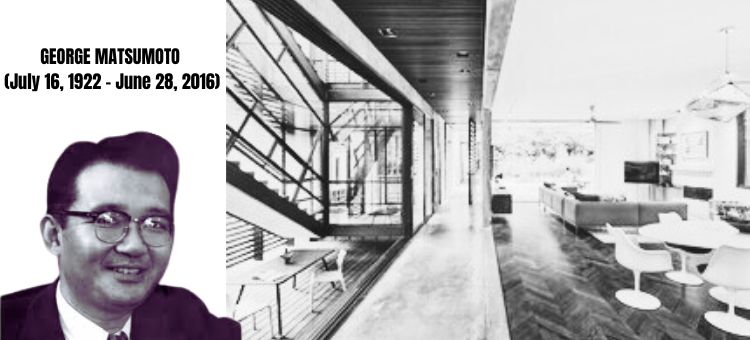
George Matsumoto grew up in San Francisco and attended the University of California at Berkeley in architecture. Disrupted, to put it lightly, by forcible relocation of Japanese-Americans during World War II, Matsumoto completed his undergraduate degree at Washington University in Saint Louis. With a scholarship to attend Cranbrook Academy of Art in Michigan, Matsumoto studied under Saarinen for his graduate degree. After graduation in 1945 with honors, he worked for Skidmore, Owings & Merrill in Chicago and in 1946 he joined Saarinen and Swanson. After a year of private practice in Kansas City (Runnells, Clark, Waugh and Matsumoto)he became an instructor at the University of Oklahoma. In 1948, Henry Kamphoefner, then head of Oklahoma's architecture program, was appointed first dean of the School of Design at North Carolina State University. Matsumoto, with several other faculty and students, left Oklahoma with Kamphoefner.
During his tenure at the NCSU School of Design between 1948 and 1961, Matsumoto won more than thirty awards for his residential work and his work was widely published. He designed a modernist addition to the school, left.In 1961 he returned to San Francisco to continue teaching at the University of California at Berkeley, and later opened a successful private practice. He is now retired and lives in Oakland, CA. Local Matsumoto houses share common characteristics: a flat roof, an unobstructed internal view from one end of the house to the other, terrazzo floors, natural woods for walls and ceilings, mahogany cabinetry, large windows in the rear, and small but highly functional kitchens. He appears in a video from Preservation North Carolina's "Farfetched and Dear Bought: Four Architects Who Changed North Carolina."
|
||
|
1949 - with
Milton Small, the Gregory Poole
Lake House on Carolina Lake off of Poole Road, destroyed. This was
part of a larger Poole family farm that is now Oakwood
Historical Park in Raleigh. The house in that park
is their former main residence. They relocated to the
Hayes Barton neighborhood but the farm remained a family
property. Gregory Poole Jr. and his father used some
earth moving equipment and built the lake. The
father commissioned Matsumoto and Small to design a
one-bedroom, 1500 sf house with lots of glass, sliding
doors, and a flat roof. Gregory Jr. went to Plymouth NC
and retrieved the heart pine timbers from a bridge that
had been demolished and they were used in the
construction of the house, along with quarried Wake
County stone; to create a structure that was modern but
rooted in local materials. The land containing the lake
and lake house was a weekend retreat for the family until
the property was sold, first to a company called
Dickerson, Inc and then to local developer Judd Ammons.
Ammons developed commercial lots but the remote location
of the lake house subjected it to repeated theft and
vandalism, including shotgun blasts. Before being
demolished, Poole retrieved the heart pine timbers once
again for reuse.
|
||
|
1950 - The Paul and June Ritcher House, 3039 Churchill Road, Raleigh. The best and most well-preserved example of Usonian design in the Triangle. 1900 sf. Built by Frank Walser. Sold to Walter and Albertina Adams in 1952. Sold in 1955 to Jack Peterson. Sold in 1970 to Stephen and Karen Renner. Sold in 1980 to Richard Boyd. Sold in 1988 to Randal Brown. Sold in 2004 to current owners Jill Anderson and Edward Bern Walser, Frank Walser's son. Right photo by David Hunt. |
||
|
1952 - The George Matsumoto House, 821 Runnymede Road in Raleigh. Neighboring land owner F. Wayne Koontz sold him the lot and Frank Walser did the construction. Sold to Banks and Louise Talley in 1961. Bought in 1974 by James Fitzgibbon clients George and Beth Paschal for their daughter, current owner Huston Paschal, former associate curator at the North Carolina Museum of Art. Between 1982 and 1985, they sold her the house in four transactions. |
||
|
1952 - The George Kelly Residence, 150 Riding Lane, Southern Pines NC. Currently owned by designer Denis McCullough, who has done the best job of adding a conventional roof while keeping the spirit of the original desigb, not an easy task with a Matsumoto home. |
||
|
1953 – The C.A. "Gus" and Marion Aretakis Residence, 309 Transylvania in Raleigh. Built by Frank Walser. Still occupied by the family. Two of Aretakis's sons, raised in this Matsumoto house, have gone on to pursue housing as a profession: one is a developer, the other an architect. |
||
|
1954 – The Julian Residence, on 101 Ledge Road in Chapel Hill. Built by Frank Walser. Designed for Milton Julian, locally known proprietor of Milton's Clothing Cupboard and uncle to international designer Alexander Julian. The family had to go to the North Carolina Supreme Court to overcome neighborhood opposition to the home's unique design. Until the area's principal developer Professor Coker's death in 1953, he or his wife had personally approved all house plans prior to construction and apparently required new home builders to consult with the university architects. Coker naturally favored the popular revival styles of the period. This design review process ceased after his death. The neighbors argued that the design was not in character with surrounding houses and attempted to use the deed restrictions in the subdivision governing aesthetic harmony to prevent Julian from building his home. They sued all the way to the North Carolina Supreme Court, which held that the design covenants were personal to Coker and therefore unenforceable. The area under the deck was soon enclosed to make a living area for the downstairs bedrooms. There is no internal stairway between floors; you have to go outside. The Julians sold to Erik Gustke in 2004. Although structurally sound, some wood beams and walls have rotted from water damage. The bathrooms are small compared to today's standards and desperately need renovation. The kitchen, however, with its 20-foot counter and floating cabinets, still amazes. Now for sale by the owner, $445,000. Erik Gustke. |
||
|
1954 – The William Moore Weber and Marcia Weber Residence, 606 Transylvania Drive, Raleigh. Matsumoto designed this in collaboration with Weber of Holloway, Weber, and Reeves. Bought by Paul and Maxine Linney in 1970. Bought by John and Penelope Sanders in 1976. Bought by current owner Joanna Johnson in 1982. |
||
|
1954 -- The Dr. George W. Poland House, originally located at 3129 Arrow Road, Raleigh, above Crabtree Valley. Over the years, the house became surrounded by commercial buildings and a giant mall. After his death in 2001, Poland's family donated the house to Preservation North Carolina. PNC put it on the market and imposed a buyer requirement to move the house to a suitable lot. Buyer Don DeFeo moved it to his 23 acres at 502 John Jones Road in Bahama, NC in 2002. The move and simultaneous downstairs addition was designed by architect Ellen Cassilly. For sale, $629,000 through Debra Smith and Peter Rumsey. Bottom photo of lower level by Sally Greene. |
||
![]() The original configuration of the rear facing the Tar River, taken during construction.
The original configuration of the front, with the garage serving to make the rest of the residence private, taken during construction.
Daughter Janet Hicks (April 1957) on the outdoor patio platform they called "the coffin."
Tom Hicks (June 1959) in the kitchen. The features such as press-to-open teak cabinets, black countertops, and pass-throughs from the open-style kitchen to the outside were all revolutionary at the time.
The Hicks added a bedroom and bathroom on the side of the house facing the Tar River plus a traditional roof on top of the flat roof which also gave them an attic.
1955 - The Thomas and Marian Hicks House, 718 Evergreen Road, Rocky Mount NC. The family stayed until 2003 and then sold to Lewis and Nancy Thorp. The Tar River flooded and caused sizable but not extensive damage. The Thorps did repairs and renovated the interior, modifying the fireplace and expanding the kitchen. To lighten things up, they painted white over many of the original cherry and mahogany paneling and shelving. Some of the iconic 50's bathroom features survive in great condition such as a blue tile shower and an alien-looking heat lamp, above. |
||
![]()
1957 - The Jeannette Lippmann Residence, 5310 Riverside Drive, Richmond VA. Photos from MidCentArc. |
||
|
1957 – The F. Wayne Koontz Residence, 817 Runnymede Road in Raleigh. Koontz admired the house his neighbor Matsumoto designed and decided to build one like it himself. Construction by NCSU School of Design students William Ross and John Duncan. Koontz sold it to George George in 1957. George sold it to Ray Pasqualone in 1962. EJ Tyson bought it in 1965 and sold it to W. Dean Best later that year. Best sold it to current owners Don and Betty Adcock. They have added a bedroom with plans by Frank Harmon. |
||
|
1958 - Tacoma, Washington. Matsumoto designed this for the Woman's Day Vacation House/Douglas Fir Plywood Association. Article Page 1. Page 2. Built for $1,500 in materials. |
||
![]()
|
||
|
1960 - Clergy Residence, Community Church of Chapel Hill Unitarian Universalist, 106 Purefoy Road, Chapel Hill. Co-designed with NCSU School of Design Professor Cecil Elliott. This house and the original sanctuary was used by church ministers until the early 1980's. It was a group home for a decade and rental property after that. An attractive brick, two-story residential structure with 1,728 gross square feet, it is equally divided between the two floors with four bedrooms and two and one-half baths. The modernist design is "upside down" with the bedrooms on the ground floor and the living room, dining room, and kitchen on the second floor. The second floor has cathedral ceilings on a 300 sf living room with fireplace. The dining room is 146 sq feet opening into the kitchen of 122 sq feet. There is also a half bath and small closet on the second floor. The second story floors are hardwood. The HVAC was replaced in 2004 and is served by natural gas. Original construction cost about $24,000. |
||
|
1959 - The J. Gregory and Irene Poole Residence, 2745 Lakeview Drive, Raleigh, designed with G. Milton Small, Jr. Built by Frank Walser. The Pooles sold this breathtakingly beautiful 3 acres property overlooking the lake at Carolina Country Club to Thomas and Molly Castelloe in 1967. After their divorce, Thomas Castelloe sold it to Thomas Rouse of Texas in 1991. Rouse tore down the house and began construction of a huge new mansion. At 90% complete, the mansion burned down during a party by trespassing teenagers. The house was rebuilt but torn down again in 1996 and sold in 1998 to current owner Robert Winston. Winston has since built Raleigh largest mansion, worth over $5.7 million, aerial shot above, right. Gregory Poole Jr. does not share his parents' affection for modern architecture (finding them, as many do, lacking in warmth) but he describes the demolition of the Lakeview house as a "tragedy." He sees the progressive ideas of Matsumoto and the School of Design at that time as being very influential and important to the history and development of Raleigh. |
||
|
1960 - The Cecile and Bryce Dewitt Residence, 702 Old School Road, Chapel Hill, Matsumoto’s largest Triangle house, built by Frank Walser. The 5-bedroom, 3300 square foot ranch on 55 acres was built for two UNC physicists and their four daughters. Each daughter had her own room with an outside door leading to a play area (above left). After moving away, the Dewitt’s rented the house to students for 15 years. Current owners David and Marsha Warren added skylights to illuminate the kitchen and family areas. Photos by George Smart. |
||
![]()
1961 - The Edwin and Polly Thrower Residence, Forsyth Drive in Greensboro NC. Cost: $85,000. After their divorce, the house was sold to John Byerly. Sold twice more since. Photos by Joseph Molitor as found on MidCentArc's photo page. Edwin Gil Thurlow was the landscape architect. Jack Cartwright was interior designer. Built by Superior Construction Company. |
||
|
1961 - The Frank
Harper and Lillian Norwood Moore Residence,
3705 Camley Avenue, Raleigh. 1.25 acres. Sold to current owners Fred and
Jane Heaton in 1976. The Heatons
believe their house
is the GE Demonstration House mentioned below but no evidence exists
for that claim as yet. Irv Pearce designed a master
bedroom/bath addition plus a rear staircase, family room, and
kitchen eating area. The existing master bedroom then
converted to a study/project room. They also replaced windows and
removed built-ins that existed in the children's very small bedrooms
and converted the two small upstairs bathrooms to one larger one
dividing the area into a vanity room and a tub/toilet room.
They closed in an upper loft area in a downstairs bedroom,
incorporated the bedroom's closet into an existing tiny bathroom,
and added access to the aforementioned loft area off the upstairs
bathroom which created some much needed storage. The addition also
added a lean to greenhouse and deck off of the rear of the house. |
||
|
1962 -
The William A. and Jean Poole Watkins Residence,
2749 Lakeview Drive, Raleigh. Jean received the land from her
parents (and neighbors) J. Gregory and Irene Poole in
1961. The Watkins sold to Joseph and Cynthia Hardison in 1966.
Hardison sold to Richard and Henrietta Badham in 1992.
No photo.
Do
you have one? |
||
![]()
1976 - The Edwin and Elizabeth
(Boots) Thrower Residence,
1 Chowan Road, Sedgefield NC. |
||
![]()
1981 - The Edwin and Elizabeth (Boots) Thrower Residence, 26 East Snapper Point Drive, Key Largo FL. |
||
|
Other houses:
1951 -
The Jackson Residence, Raleigh, designed with
Holloway, Weber, and
Reeves.
|
Sources: George Matsumoto, Thomas Castelloe, Mary Erazim, David and Marsha Warren,
Eric Gustke, Bern Walser,
NCSU School of Design, Greg Raschke, Catherine
Bishir, Mary Thorp, Sarah Adams, Margaret Adams,
Preservation North Carolina,
David Hunt,
Matt Jones,
Dwell
Magazine, Janet Hicks Bethune,
Matsumoto Archive at
NCSU,
School of Design: The Kamphoefner Years 1948-1973 by Roger Clark,
Cleon Hayes,
MidCentArc Photos,
Boots Thrower, Architectural Record Houses of 1961, John Stevens,
.