Triangle Modernist Houses

Compiled by George Smart, Jr.                                                          

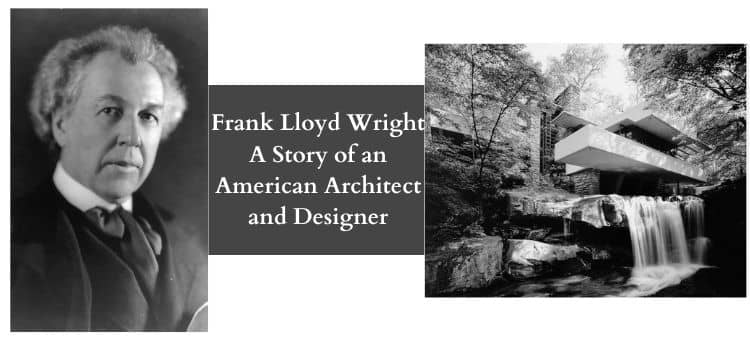
FRANK LLOYD WRIGHT (1867-1959)

Wright was a pioneer in the modern style and one of the greatest figures in 20th-century architecture. He was born in Richland Center, Wisconsin. In 1887 Wright went to Chicago, where he became a designer for the firm of Adler and Sullivan. In 1893 he established his own office in Chicago. Wright created the philosophy of "organic architecture," which maintains that a building should develop out of its natural surroundings. His designs for both private and public structures were boldly original, and he rebelled against ornate neoclassic and Victorian styles. Wright believed that architectural form must be determined by the particular function of a building, its environment, and the type of materials used. His interiors emphasize spaciousness, which derives from open planning with one room flowing into another.

Frank Lloyd Wright was married three times and fathered seven children: four sons and three daughters. He also adopted Svetlana Wright Peters, the daughter of his third wife, Olgivanna Lloyd Wright. One of Wright's sons, Frank Lloyd Wright Jr., known as Lloyd Wright, was a notable architect in Los Angeles. Another son and architect, John Lloyd Wright, invented Lincoln Logs in 1918 and practiced extensively in the San Diego area. The Oscar-winning actress Anne Baxter was another granddaughter. She was the daughter of Catherine Baxter, from Wright's first marriage.


Lloyd Wright's son (and Wright's grandson), Eric Lloyd Wright, is currently an architect in Malibu.

John's daughter, Elizabeth Ingraham, is currently an architect in Colorado.


Wright initiated many new techniques, such as the use of precast concrete blocks reinforced by steel rods. He also introduced numerous innovations, including air conditioning, indirect lighting, and panel heating. In 1959 he completed the Solomon R. Guggenheim Museum in New York City.  Wright also spent much of his time writing, lecturing, and teaching. By 1908 he had originated most of the principles that serve as fundamental concepts of modern architecture. His work profoundly influenced the development of contemporary architecture in the United States and Europe.

Perhaps one of the most unique ways that Wright is recognized today is the fact that five properties designed by him are actually available to house overnight guests who, more than simply touring his houses, want to "live" in one, albeit for a night or two. The houses include the Louis Penfield House in Ohio, the Haynes House in Indiana, the Schwartz House in Wisconsin, the Duncan House in Pennsylvania and the Seth Peterson Cottage in Wisconsin.

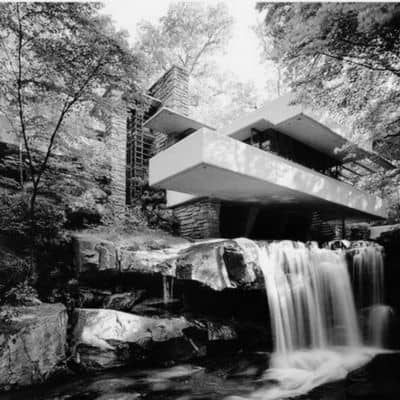
He designed many homes but his masterpiece is Fallingwater in Mill Run, Pennsylvania.  If you have not been, this pilgrimage is well worth a trip to the Pittsburgh area.  Be sure to take one of the extended tours early in the morning.  Seeing this close up is nothing short of amazing, as is this 3D recreation on YouTube:


Here are pictures from my visit to Fallingwater, July 2007:

Sources: Wikipedia, David Hunt, George Smart, Sally Greene,
 School of Design: The Kamphoefner Years 1948-1973 by Roger Clark.